

Finally, the promised child, Isaac is born. Although the birth of Isaac brings incredible joy, it also leads to tensions in the home leading to another parting. Just when Abraham sees all that he has hoped for, he faces his biggest crisis, he is asked to make an unspeakable sacrifice of all that he has hoped for. Will he place his trust in God?
PART III – THE CRISIS
SERIES OPENER – In a world ruled by fear and superstition, one man’s faith would shape history. Called to leave his past, he stepped into the unknown. Guided by a promise, his faith was stretched to its limits. A legacy was born that would shape generations and change the world.
This is the story of Abraham.
INTRODUCTION
Abraham, one of the most well-known patriarchs, a father of nations, is about to face the ultimate test, the kind of heart-wrenching decision that keeps you awake at night, staring at the sky and wondering what the future holds and if you’re making the right choice.
The birth of the miracle child, a son, has brought unbelievable joy but also distressing tension to his home. But then Abraham faces a heart-breaking decision, a test so profound it’s unimaginable. Would you still choose to trust in God if you were asked to sacrifice everything you’ve waited for, prayed for, longed for?
Join me as we walk with Abraham through his darkest valley as he faces his biggest crisis, an unspeakable sacrifice. What will Abraham do? Will he doubt and question God? Or will he trust God? It’s an unbelievable and unimaginable test that establishes a legacy for all time – one that reaches right down to our day.
-Title Block-
FAMILY MOVES
One of the most gripping chapters of Abraham’s story comes after the fiery destruction of Sodom and Gomorrah.
Abraham had moved his family and all his belongings from Mamre, southwest towards the coast. They settled near the city of Gerar, an ancient centre of seafaring warriors called Philistines who were ruled by a king named Abimelech.
Now the Philistines are mentioned many times in the Bible, especially about 1000 years after Abraham, during the time of King David, when there was repeated conflict between the two nations. One of the most famous being the battle between David and Goliath.
Abraham, the man who’s walked with God, fought kings, and survived the drama of Sodom and Gomorrah, now arrives in Gerar and his old fears come back to haunt him. It’s the exact same fear he has faced before, and he makes the exact same choice that leads to the exact same ending.
Why? Because even in later life his wife Sarah, is still renowned for her beauty and is still turning heads. So, Abraham was worried that the people in Gerar might kill him to take his wife.
MISTAKE REPEATED
So, forgetting about God’s promises of protection and his past experiences, Abraham tells King Abimelech of Gerar that Sarah was his sister. Remember this wasn’t the first time Abraham had used this lie – he’d done the same thing years before in Egypt with the Pharaoh.
In Egypt, Abraham’s fears for his life had led him to compromise his honesty and deceive Pharoah into thinking that Sarah was only his sister, not also his wife. But then God had to intervene with plagues to protect Sarah while she was in Pharoah’s harem.
Now it happens again in Gerar. At this time, it was common practice for powerful rulers to take beautiful women into their household. So, King Abimelech sends for the beautiful Sarah, not realising that she was married and Abraham’s wife. And so, once again, God intervenes to protect Sarah and keep the Covenant promise.
In a dream, God warns Abimelech that he was as good as dead because he had taken a married woman into his household. Shocked, Abimelech pleaded with God, explaining that he didn’t know Sarah was married and that he hadn’t touched her.
God acknowledged Abimelech’s innocence and intervened once again to prevent a bigger mistake and trouble in the kingdom.
But, instead of reacting with anger towards Abraham and his deception, Abimelech acted with kindness and generosity. He gave Abraham sheep, cattle, servants, and a thousand pieces of silver as a sign of his goodwill. This generous gift was also meant to clear Sarah’s name and restore peace between them.
What’s ironic is that Abimelech showed more honesty and respect than Abraham, who had let his fears lead him to deception instead of trusting in God.
A PROPHET APPEARS
In his dream, God also told Abimelech that Abraham was His ‘prophet’ and would pray for him. Now, can you imagine what Abimelech thought? This patriarch who couldn’t tell the truth about his wife is supposed to be a prophet and pray for him?
Now this is the first time the word prophet appears in the Bible. A prophet is an inspired person who has special contact and communication with God and who speaks to God on behalf of people. Abraham had prayed for Sodom and Gomorrah before, and now he was called to pray for Abimelech and the people of Gerar.
But that’s the beauty of how God works: He uses imperfect people in perfect ways. Abraham, who moments ago was too scared to trust God with his life, is now called to be the spiritual bridge between God and Abimelech’s people, the very people he had wronged.
Isn’t there something wonderfully hope-filled about that? Even when we mess up, God can turn our mistakes into miracles, our failures into fertility, and our blunders into blessings.
And Abraham prayed for Abimelech and his household. You see God had stopped the women in Abimelech’s household from having children because of what happened with Sarah. But after Abraham prayed, God healed them, restoring their fertility.
Now, while Abraham is busy being a blessing to others, God is quietly working behind the scenes on that impossible promise of a child for him and Sarah.
Can you imagine that morning when Sarah suddenly realizes she’s pregnant? After twenty-five years of waiting, after countless disappointments, the long-awaited promise is fulfilled. In God’s perfect timing, the impossible becomes possible, and the dream they’d almost stopped dreaming becomes a reality!
BIRTH OF ISAAC
And Sarah gave birth to a son and Abraham named him Isaac, which means ‘laughter.’ This name reflected both Abraham and Sarah’s wonder and even disbelief at God’s promise, as well as the joy they felt when Isaac was born.
Isaac’s birth is truly a miracle. A ninety-year-old mother and a hundred-year-old father? It’s like God waited until it was absolutely, positively, biologically impossible before saying, “Now watch what I can do!”
This promise could not have come true without Abraham and Sarah playing their part. The fact that they were still close and loving after so many years of marriage shows their strong relationship and their faith in God’s promise.
The love they felt for Isaac must have been immense and overwhelming. It wasn’t just a moment of happiness for them, but also for their entire household that had waited so long for this blessing.
For Sarah, who had been unable to have children, Isaac’s birth was proof of God’s faithfulness and a sign of her own worth.
All her life Sarah had carried the weight of being ‘barren’ in a culture that measured a woman’s worth by her children. Now every time she looks at Isaac, she sees living proof that God hadn’t forgotten her.
And Abraham? The man who’d been told to count the stars, and imagine and picture the number of his descendants, is now holding his promised son!
RIGHT ON SCHEDULE
Isn’t it amazing how God often waits until something seems absolutely impossible before showing up with a miracle? It’s like He enjoys turning our ‘too late’ into His ‘right on time’.
As Isaac grew older, the time came for his weaning— a big deal in ancient times. Back then, children were usually weaned at around three years old.
This celebration meant the child had survived the dangerous early years of infancy and was ready for the next stage of life. Abraham now holds a big feast – the finest food and music. The whole camp is celebrating because this is his miracle child, the son of the promise!
RENEWED TENSION
But the joy of the celebration becomes clouded by tension in the household. During the feast, Sarah noticed Ishmael, Abraham’s teenage son with Hagar, mocking little Isaac.
There’s a powder keg of emotions here: Ishmael, the firstborn son is now suddenly playing second fiddle to the new miracle baby. There’s Hagar, the maidservant, the mother of Ishmael, who now scorns her mistress, Sarah.
There’s Sarah, who had endured years of anguish, watching another woman’s son grow up in her household while she remained barren. Then caught up in the middle is Abraham, loving both his sons, but watching the conflict erupt around him.
Sarah, feeling protective of Isaac, demanded that Abraham send Hagar and Ishmael away because she feared that Ishmael might threaten Isaac’s inheritance.
This demand broke Abraham’s heart because Ishmael was his son too and he loved him. Abraham had once hoped that Ishmael would be the child of promise. But God told Abraham to listen to Sarah and to let Hagar and Ishmael go.
Abraham is torn by his love for Ishmael. How can he send his first-born son away? But he has to trust in God’s plan and the promise that Ishmael will also become the father of a great nation.
HAGAR AND ISHMAEL MOVE ON
Early the next morning, with a heavy heart, Abraham gave Hagar some bread and water and sent her and Ishmael on their way. They set off, heading south-east to find the road leading to Egypt, Hagar’s homeland.
As they walked through the dry, barren terrain, their water ran out, and Ishmael collapsed from thirst. In her despair, Hagar placed him under a bush and walked away, unable to watch her son die.
But then, God heard Ishmael’s cries and spoke to Hagar, saying,
“What troubles you, Hagar? Fear not, for God has heard the voice of the boy where he is. Up! Lift up the boy, and hold him fast with your hand, for I will make him into a great nation.” (Genesis 21:17-18)
God opened Hagar’s eyes, and she suddenly saw a well of water nearby. She filled the water skin and gave it to Ishmael to drink, restoring him.
They may have been exiles from Abraham’s tent, but they were not exiles from God’s sight. Hagar and Ishmael continued to live in the wilderness, and we are told that God was with them.
A NEW AGREEMENT
Now, in the meantime, King Abimelech of the Philistines had been watching Abraham and noticed how he was blessed by God. So, he approached Abraham with a proposal to make a peace covenant – known as a parity agreement.
This was a common practice in those days. It was a solemn promise between two equal parties to be kind to each other and to treat each other’s descendants fairly.
Abimelech then also reminded Abraham of the kindness he had shown him in the past and asked Abraham to always treat him with honesty and respect.
Abraham agreed to the treaty, but also took the opportunity to bring up the problem his herdsmen were having with Abimelech’s servants seizing the well, the very well where Hagar and Ishmael had been. Abimelech responded, and said he knew nothing about the dispute.
But Abraham wanted to show his ownership of the well and so gave Abimelech seven female lambs, symbolizing that the well indeed belonged to him. [This] act led to the founding of Beersheba, a name that means both ‘well of the oath’ and ‘well of the seven.’
Then, to show his faith in God’s promises, Abraham planted a tamarisk tree at Beersheba. This kind of tree can grow up to 10 meters tall and offers plenty of shade, and it became a place of worship and spiritual renewal for Abraham.
Abraham continued to live in the area of the Philistines for a long time. And it was during these years that Isaac grew into a young man, deeply loved and guided by Abraham, Sarah, and their entire household.
A COMMAND FROM GOD
One night, God called out to Abraham. Recognizing the voice of his divine friend, Abraham quickly responded,
“Here I am!” (Genesis 22:1)
The word he used showed that he was completely open and ready to do whatever God asked.
But this visit from God was different from the six times before. This time, there wasn’t a promise; instead, it was a test. God said,
“Take your son, your only son Isaac, whom you love, and go to the land of Moriah, and offer him there as a burnt offering on one of the mountains of which I shall tell you.” (Genesis 22:2)
Now, this command seems shocking and impossible to understand. Isaac wasn’t just Abraham’s beloved son; he was the fulfilment of God’s promises. Readers of the Bible have often found this story confusing, especially if they only look at it by itself and in isolation.
A DEEPER MEANING
It seems so out of character for God, but when seen as the climax of Abraham’s journey with God, it takes on a deeper meaning.
The Bible says that God was “testing” Abraham. In Hebrew, the word for “test” means it was a trial of Abraham’s faith, not a temptation to do something wrong. The idea of sacrificing Isaac reminds us of the customs in the ancient world, where people sometimes sacrificed children to please their gods.
But Abraham’s God is different. This test wasn’t about a cruel demand for a sacrifice; it was about revealing how much Abraham truly trusted and obeyed God.
Throughout his life, Abraham had struggled with fear. When God first called him in Ur, he moved, but stayed in Harran until his father died. Later, when he finally arrived in the promised land, he fled to Egypt at the first sign of trouble and famine.
During his journey in Egypt and in Gerar, he lied about Sarah being his wife because he was afraid someone would harm him so they could take Sarah.
Abraham also doubted God’s promises. When God spoke of descendants as numerous as the stars, without the promised son, Abraham looked to his servant Eliezer, seeking to make him the heir.
And later, at Sarah’s insistence he fathers Ishmael with Hagar, rather than waiting for the promised child through Sarah. What a complicated situation. And what an enigma Abraham was!
You see, Abraham had already given up his past, leaving his home and family when God called. He had given up his present hopes by sending away his son Ishmael. And now, God was asking him to give up his future – his son Isaac, the one who represented everything Abraham hoped for.
THE ULTIMATE TEST
This was the ultimate test. This request struck at the very core of who Abraham was and everything he believed about God’s promises to him. Isaac was the child of laughter and promise, his legacy, the living embodiment of everything Abraham had ever hoped for.
What would Abraham do? Would the man who once fled from fear now stand firm in faith?
The Bible record tells us that Abraham set out early the next morning, taking Isaac and two young men with him, along with a donkey to carry their supplies. They travelled for three days to reach the place God had chosen, a region called Moriah.
This name is mentioned only twice in the Bible: in this story and in connection with King David, near Jerusalem. The last time Abraham had been in this area was when he defeated a group of warring kings and met with Melchizedek. Now he was returning, facing a very different kind of struggle.
Salem, the ancient name for Jerusalem, was about 65 kilometers from Beersheba, where Abraham lived. A loaded donkey could travel about 25 kilometers in a day, so it would have taken them three days to reach Moriah at a steady pace.
For Abraham, this journey was likely filled with deep thought and prayer, as he tried to understand the difficult command God had given him. When they finally neared the mountain, Abraham told the two [other] men to stay behind while he and Isaac went up to worship.
He said to the servants,
“Stay here with the donkey while I and the boy go over there. We will worship and then we will come back to you.” (Genesis 22:5)
ABRAHAM’S CONFIDENCE
Abraham says that both he and Isaac would return. This showed Abraham’s faith – even in the face of such an impossible command, he believed that somehow, God would work everything out.
As Abraham and Isaac climbed the mountain, Isaac noticed they had the wood, and a knife, but no animal for the sacrifice. Curious, Isaac called out,
“Father!” And Abraham replied, “Here I am, my son.” Then Isaac asked, “Where is the lamb for the sacrifice?” And Abraham answered, “God will provide for Himself the lamb for a burnt offering, my son.” (Genesis 22:7-8)
When they reached the place that God had chosen, Abraham built an altar, arranged the wood, and tied up Isaac, laying him on top. This moment not only showed Abraham’s faith but also how that faith was passed on to Isaac.
Isaac had to have trusted his father completely to help build the altar and then allow himself to be tied up and laid on it. Then, just as Abraham was about to sacrifice his son, the Angel of the Lord called out urgently,
“Abraham, Abraham!” Abraham stopped immediately and replied, “Here I am.” (Genesis 22:11)
The Angel said,
“Do not lay your hand on the boy or do anything to him, for now I know that you fear God, seeing you have not withheld your son, your only son, from me.” (Genesis 22:12)
THE LORD PROVIDES
Then, God provided a ram caught in a nearby thicket to take Isaac’s place as the sacrifice. This moment was profound, not just because it saved Isaac’s life, but God once again repeats and confirms his promise to Abraham:
“The angel of the Lord called to Abraham from heaven a second time 16 and said, “I swear by myself, declares the Lord, that because you have done this and have not withheld your son, your only son, 17 I will surely bless you and make your descendants as numerous as the stars in the sky and as the sand on the seashore. Your descendants will take possession of the cities of their enemies, 18 and through your offspring all nations on earth will be blessed, because you have obeyed me.” (Genesis 22:15-18)
Abraham named the place ‘The Lord Will Provide,’ or in Hebrew, ‘Yahweh Yireh.’ This place would later become Temple Mount and the site of Solomon’s Temple, a sacred place where God’s presence would rest and where people would come from all over to worship.
This name shows Abraham’s faith that God sees our needs and provides for them, often in ways we don’t expect or understand.
When Abraham and Isaac returned to their two waiting companions, they were filled with amazement at what had just happened. Isaac had just witnessed God’s Covenant for the first time and heard the voice of God.
Abraham’s faith had been tested like never before. God’s test was designed to help Abraham face his deepest fears and learn to trust in God completely. From the birth of Isaac to the test on Mount Moriah, Abraham’s journey teaches us about the importance of trust, obedience, and believing that God always keeps His promises.
When storms gather in our lives, when our lives are in crisis or our faith is being tested – Abraham’s story reaches across the centuries to speak to our hearts. For in this ancient drama on Mount Moriah, we see reflections of our own struggles.
But we also see something profound: a God who doesn’t just make promises, but keeps them. His faithfulness never fails. The God who met Abraham on that mountaintop still walks beside us today.
SPECIAL OFFER AND CLOSING PRAYER
If you would like to find out more about Abraham’s story and God’s promises, then I’d like to recommend the free gift we have for all our Incredible Journey viewers today.
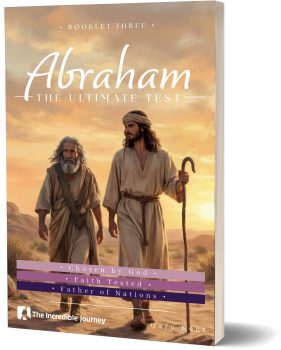
It’s the booklet, Abraham: The Ultimate Test. This booklet is our gift to you and is absolutely free. I guarantee there are no costs or obligations whatsoever. So, make the most of this wonderful opportunity to receive your free gift today.
-Contact Details-
If you have enjoyed our journey with Abraham to Mount Moriah for his ultimate test and our reflections on the importance of our faith and trust in God, then be sure to join us again next week when we will conclude our thrilling journey with Abraham. Until then, let’s pray.
Dear Heavenly Father, we thank you for the story of Abraham and the reminder of your faithfulness, your love and your mercy. We want to trust you and your promises like Abraham did and put our faith in you. We pray that you will continue to guide our lives, and that you will bless us and our families. In Jesus’ name we pray. Amen.
*****