

In 1975, the Cambodian capital of Phnom Penh fell to a rebel movement known as the Khmer Rouge. These Marxist revolutionaries seized control of the country and unleashed a reign of terror rarely seen in modern history. Over the next four years, the regime, led by dictator Pol Pot, was responsible for the deaths of nearly a quarter of Cambodia’s population. Entire communities were destroyed, and the nation’s religious and cultural heritage was systematically dismantled.
The horrors of the Cambodian killing fields are difficult to confront, but they cannot be ignored. In a 1948 speech to the British House of Commons, Prime Minister Winston Churchill warned, “Those who fail to learn from history are condemned to repeat it.” So what can we learn from the story of the Cambodian killing fields — and how can we ensure such a tragedy is never repeated?
FREE OFFER: The Desire of Ages
(Click the image to request this free offer)
INTRODUCTION – CHOEUNG EK
This is Choeung Ek Genocidal Center, the most notorious of Cambodia’s 300 Killing Fields. A brutal place of fear, death and mass graves. Over 1 million people were killed and buried by the Khmer Rouge regime. So how did this awful tragedy happen?
Well, after five years of a violent civil war between the Cambodian government and a group of rebel fighters called the Khmer Rouge, the Cambodian capital of Phnom Penh fell into the hands of the Khmer Rouge in April of 1975.
Now, the Khmer Rouge were a group of communist revolutionaries led by Pol Pot, who were bent on overthrowing the Cambodian government.
When the Khmer Rouge rebels first entered Phnom Penh, many people were overjoyed, believing that they would usher in an era of peace and prosperity.
The Khmer Rouge even used their well-rehearsed party line of justice and equality to win the hearts of the people. They touted ideals of sacrifice for the greater good of the nation so that Cambodians would support them.
But the dream of freedom and prosperity soon turned into a harsh and unforgiving nightmare. As soon as they seized power, the Khmer Rouge began to make some dramatic and rapid changes.
Claiming that the Americans were planning an imminent military assault against Cambodia, the Khmer Rouge forced millions of Cambodians to evacuate the cities and seek shelter in the countryside.
This move, which seemed chaotic, was really systematic and well planned. The move didn’t just force Cambodians out of the cities, it also separated families and broke up communities and social networks.
To add to the turmoil and confusion, the Khmer Rouge began to confiscate private property. Separated from their families and community networks, and divested of their homes and property, the Cambodian dream of liberty and equality began to edge towards a terrible nightmare.
But this was just the beginning. To ensure that the nation remained strong, the Khmer Rouge killed small children, elderly women and sick patients lying in hospital beds.
Next came the systematic genocide of upper middle-class professionals, artists, writers and all those who were deemed to be part of the educated elite of society. Men were arrested and separated from their families, never to be seen again.
Once the men were taken, children who were old enough to work, and healthy able-bodied women were either massacred or taken to forced labour camps, where they worked up to eighteen hours a day with nothing more than a bowl of soupy rice to sustain them.
The Cambodian killing field here at Choeung Ek, once a tranquil orchard, has become infamous.
Here, you follow the final pitiful footsteps of innocent people brought here for execution. The truck would drop them off here, and they were taken to the dark and gloomy detention office after that. The next stop would be the executioner’s working office. Then a little further is the mass grave where hundreds were executed and then buried.
Probably one of the most confronting sights here is the Killing Tree. This giant tree looms over the orchard and claimed the lives of many innocent children whose tiny bodies were bashed lifeless here.
Nearby is the Buddhist Stupa, a memorial erected to the memory of the victims. Thousands of skulls are arranged in order of age and sex. It’s impossible not to stare into the empty eye sockets and wonder what tortures they suffered, and what horrors they witnessed before their death.
It’s almost impossible to comprehend the horrors that transpired here on these killing fields. Nearly a quarter of the Cambodian population, approximately 1.7 million victims, were killed.
We’ve heard stories of the Russian revolution, the Holocaust and the Rwandan genocide, but the story of the Cambodian killing fields and the brutality of the Khmer Rouge is not as well known. So join me as we take a closer look at this chilling story of a country torn apart by war, political instability and mass genocide – and the lessons we can learn from it.
-Title Block-
In the mid-1950s Cambodia was a country poised on the brink of a bright and prosperous future. Most of the population are Buddhist, and peace-loving people whose colourful pagodas are found across the country.
No longer colonized by the French, the country was peaceful and politically neutral. The capital Phnom Penh was called the ‘pearl of Asia’ and considered the most beautiful French-built city in all of Asia.
THE VIETNAM WAR
But unfortunately the fairy tale didn’t last long. Cambodia was soon dragged into the midst of the Vietnam War in the 1960s.
The Vietnam War was both ugly and brutal. It was a warzone that changed the future of thousands of men, women and children and shaped not just a country, but a region as well.
In an attempt to overthrow the South Vietnamese Government, which was heavily backed by the United States, North Vietnam formed the National Liberation Front for North Vietnam, or also known as the Viet Cong.
The Viet Cong were a group of communist revolutionaries made up of both guerrilla and traditional army units, bent on uniting Vietnam through an armed revolution.
Under the direction of North Vietnam, the VietCong fought against the governments of South Vietnam and the United States to gain control over South Vietnam.
THE HO CHI MINH TRAIL
A vital part of the Viet Cong strategy was the Ho Chi Minh trail. Now the Ho Chi Minh trail was a network of roads and trails that acted as a supply route to move militants, ammunition and goods.
Without the Ho Chi Minh trail the Viet Cong would not be able to move across the border between North and South Vietnam undetected, nor would they be able to organize supplies.
Large parts of the Ho Chi Minh trail ran through Cambodia and Laos. The strategic significance of the trail meant that the North Vietnamese government had a vested interest in introducing and nurturing the seeds of Marxist ideology within Cambodia.
As the Vietnam War progressed Viet Cong insurgents pushed deeper into the Cambodian heartland in search of shelter and a place to regroup. It wasn’t long before the North Vietnamese army was quietly training a small group of Cambodian guerrilla fighters who were dedicated to Marxism.
THE KHMER ROUGE
Dubbed the Khmer Rouge, the group’s main focus was to cause a revolution that would overturn the existing government and establish a Marxist state within Cambodia, thus creating a regional network of Marxist states linking Vietnam, Cambodia and Laos to the larger Marxist states like China and the Soviet Union.
To this end the Khmer Rouge was armed and supplied by the North Vietnamese, Chinese and Soviet governments, and soon became a force to be reckoned with within the Cambodian countryside.
Before long, the Khmer Rouge had taken over areas of the North and East of the country, while the Cambodian government retained control of the remainder of the country, including the cities.
The Khmer Rouge made significant inroads throughout the country, gaining more territory by burning villages and taking small towns captive. They also aggressively recruited Cambodian youth to join the fighting and embrace their revolutionary cause.
After five years of civil war that gouged a trail of blood and tears through the heart of Cambodia, the Khmer Rouge surrounded the capital, Phnom Penh. Then on 17 April 1975 the communist insurgents took control of the city. The leader of the Khmer Rouge, Pol Pot became the new Prime Minister of Cambodia.
The Khmer regime turned Cambodia into a one-party state, ironically named Democratic Kampuchea. The goal of the new regime was to create an agrarian socialist society built on the backs of forced labour exacted from citizens.
REIGN OF TERROR
Over the next four years they administered a reign of terror over the innocent people of Cambodia that has been rarely seen or rivalled for its horror. The majority of the victims were first taken to the prison cells in Tuol Sleng, also called S-21, or Security Office 21.
It was the secret centre of a network of nearly 200 prisons where people were tortured by the Khmer Rouge. Here prisoners were detained for months, routinely tortured and interrogated before being taken to the killing fields. Around 20,000 people were imprisoned here. There are only 12 confirmed survivors.
This museum chronicles the Khmer Rouge’s heinous crimes: forced labour, mass killings, confiscation of private property, the destruction of all national and cultural institutions and, above all else, the decimation of the family units.
The Cambodian genocide under the Khmer Rouge is estimated to have claimed the lives of nearly a quarter of the entire population of Cambodia within the space of just four years.
Perhaps the most significant devastation that the Khmer Rouge inflicted on Cambodian society was to wipe out its educated middle class.
Simply because of their education and social standing, they were labelled enemies of the state. To be educated and a working professional meant, in the eyes of the Khmer Rouge, that you were lazy and living off the blood and sweat of the farmers and the poor.
Marxist states generally curb the freedoms of their citizens in four specific ways: freedom of religion, freedom of speech, freedom of the press and freedom of assembly.
They also use fear as a method of control, and enforce an environment where individual voices and opinions are swallowed up in the opinions and voices of the whole.
That generally means the ruling party members get to decide what everyone thinks and feels. This pattern has been repeated in varying degrees across all states that have had Marxist leanings.
While the Khmer Rouge adopted these same restrictions and methods they went one step further and attacked the two foundational pillars of most Judaeo-Christian societies.
The Khmer Rouge repressed religious freedom and decimated the family unit. They hoped to create a super state of mindless activists, made up of millions of children who had been stripped of their childhoods and family ties.
That single trait, above all others, made the Khmer Rouge more brutal and more ruthless than many other Marxist revolutionary states that sprang up during the 20th century.
HAUNTING STORIES
The stories of the survivors of this terrible time are especially haunting. In so many ways, storytellers are the curators of both historical and social change. More than the generic retelling of historical events, it’s the stories of individuals who experienced those events that makes history come alive.
The stories of the children of Cambodia’s killing fields opens up an entirely new picture of the damage inflicted on the future of the nation during the four years the Khmer Rouge was in power.
The children who lived under the Khmer Rouge were surrounded by constant darkness and fear. Closing their eyes to sleep became one of the most terrifying aspects of life.
One survivor recalled that sleep was nearly impossible because of the constant patrolling of the Khmer Rouge soldiers throughout the camps. There was constant fear that none of them would live to see the next sunrise.
Children who were evacuated from the cities were dragged through the jungles which were filled with dangerous animals and hazardous conditions. They were constantly kept off balance as a psychological tactic to keep them submissive.
Many of the children were sent to labour camps where they were forced to work ten hours a day with very little food. They built dams and trenches, swinging equipment that was often much too heavy for them to use.
Survivors recall how the Khmer Rouge came into villages and took children who had just been weaned from their mothers and placed them in the care of female members of the Khmer Rouge.
This was done to both sever the ties between mother and child and to ensure that the mother would be able to work more effectively for the state.
Many of the children who were taken, from the toddlers to the older children would often cry and ask for their parents. When this happened Khmer Rouge soldiers who were in charge of them would beat them until they stopped crying.
Boys who were around ten or eleven and older were often taken out to build roads and bridges. The work was backbreaking and lasted for days with very little food or time to rest. More often than not the boys would collapse from sheer exhaustion at the work site.
Some of them managed to escape over the border into Thailand or other neighbouring countries. But their lives didn’t really improve. They managed to find manual labour in homes or businesses, but they held out little hope of ever seeing their families again.
MAKING SENSE OF IT ALL
How do we make sense of this dark and violent part of world history? As a global community we have seen some of the worst instances of cruelty throughout the 20th century.
World War I; World War II and the Holocaust; The Vietnam War; the multiple instances of genocide in Rwanda, Srebrenica and Turkey; The Marxist revolutions in Russia, China, Cambodia and other places.
Human history is steeped in violence and bloodshed. The stories we hear about those who survived some of the worst episodes of history are stories of pain, suffering and resilience during a time without hope.
Now, while it is true that there are many instances of compassion and kindness during these times in history, we also come face to face with the dark side of human nature and we are left to ask the question; Why?
Why is there so much suffering and killing and bloodshed in our world? Why do we inflict such pain on each other? Well, I believe the Bible provides the best answer.
FAR BACK IN TIME
The Bible says that the sad history of human sin and suffering goes far back into the past, to a time and place before time on earth began, and before our planet even existed. Surprisingly, It began in a place that was full of freedom and light; probably the unlikeliest place for sin to begin.
The Bible says in Revelation 12:7,
“Now war arose in heaven, Michael and his angels fighting against the dragon and the dragon and his angels fought back.”
War began in heaven and originated with Satan. The name Satan means ‘adversary’. Now before he became Satan, he was a mighty angel, a majestic being created by God. His name was Lucifer, which means ‘lightbearer’.
So how did the transition from lightbearer to adversary take place? What happened in heaven? The Bible book of Isaiah 14:13-14 gives us an explanation;
“You [Lucifer] have said in your heart: I will ascend into heaven, I will exalt my throne above the stars of God; I will also sit on the mount of the congregation on the farthest sides of the north; I will ascend above the heights of the clouds, I will be like the Most High.”
Lucifer’s all-consuming desire to exalt himself and become God led to his downfall. He wanted to have God’s power.
COMPETING IDEOLOGIES
The war in heaven was fought over two ideological frameworks. First, the ideological framework of the government of God that is self-sacrificing love and service for the blessing and benefit of others.
In contrast to this is the second ideological framework, that of Satan which is driven by pride, self-exaltation, and a lust for power and influence. So, while God’s ideological framework is driven by love and service, Satan’s ideological framework is driven by greed and exploitation.
This conflict that began in heaven spilled over to our earth. Revelation 12:9 says,
“So the great dragon was cast out, that serpent of old, called the Devil and Satan who deceives the whole world; he was cast to the earth and his angels were cast out with him.”
Satan was cast out to the earth. Now, does that mean God created the earth as a dumping ground to get rid of Satan? A kind of quarantine station so that he could isolate a terrible problem?
Definitely No! The earth became Satan’s primary base of operations when humanity chose to buy in to his lies.
Genesis 3:1-6 describes how Satan deceived Eve in the garden. After casting doubt on the validity of God’s word, Satan enticed Eve with an alluring, but very dangerous proposition. Referring to the forbidden fruit he told her,
“For God knows in the day you eat of it your eyes will be opened, and you will be like God, knowing good and evil.”
The temptation that Satan presented to Eve hinged on the ideology he embraced; a desire to be like God. Not like God in character, but to acquire the power that God inherently possesses.
Genesis 3:6 tells us,
“So when the woman saw that the tree was good for food, that it was pleasant to the eyes and a tree desirable to make one wise, she took of its fruit and ate. She also gave to her husband with her, and he ate.”
Adam and Eve chose to buy into Satan’s ideology. A worldview based on the pursuit of self-interest and power. The sad record of human history points to the fact that each successive generation has chosen the same thing, and bought into the same selfish ideology.
The history of the Khmer Rouge is a variation on this same theme. The pursuit of self-interest and power has always led to war, bloodshed, hatred and pain. We live in a world largely preoccupied with power and hedonism, and history tells us that both these paths only lead into an abyss of pain and suffering.
But the Bible offers us hope. While human history is littered with examples of what the ideological framework of Satan looks like in practice, the fulcrum of history demonstrates the ideological framework of God.
FULCRUM OF HISTORY
What is this fulcrum? The cross of Jesus. The cross of Christ is a demonstration of self-sacrificing love and service offered to undeserving humanity. Jesus died so that even the very people who nailed him to the cross could have a second chance at something better.
And He offers us that same opportunity as well. No matter what mistakes we’ve made, Jesus offers us a second chance. He offers us eternity.
The Bible paints a picture of that future in the book of Revelation in these words,
“Now I saw a new heaven and a new earth, for the first heaven and the first earth had passed away…and God will wipe away every tear from their eyes; and there shall be no more death, nor sorrow, nor crying. There shall be no more pain, for the former things have passed away” (Revelation 21:1-4)
SPECIAL OFFER
God has promised us a world with no more suffering, pain or death. If you would like to find out more about this promise and the hope that Jesus can bring, then I’d like to recommend the free gift we have for all our Incredible Journey viewers today.
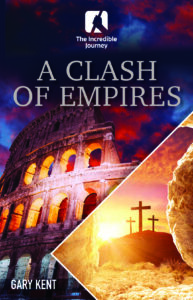
It’s the booklet, A Clash of Empires. This booklet will share with you the origin of sin and how God has provided a way to rescue us. This booklet is our gift to you and is absolutely free. I guarantee there are no costs of obligations whatsoever. So, make the most of this wonderful opportunity to receive your free gift today.
-Contact Details-
Dear Heavenly Father, we live in a world that’s broken, that’s full of pain and suffering. Only You can fix it. You are our only hope. We look forward to the coming of Jesus and a new world of peace and happiness. Please grant us a place in Your kingdom. And we ask this in Jesus’ name, Amen.